

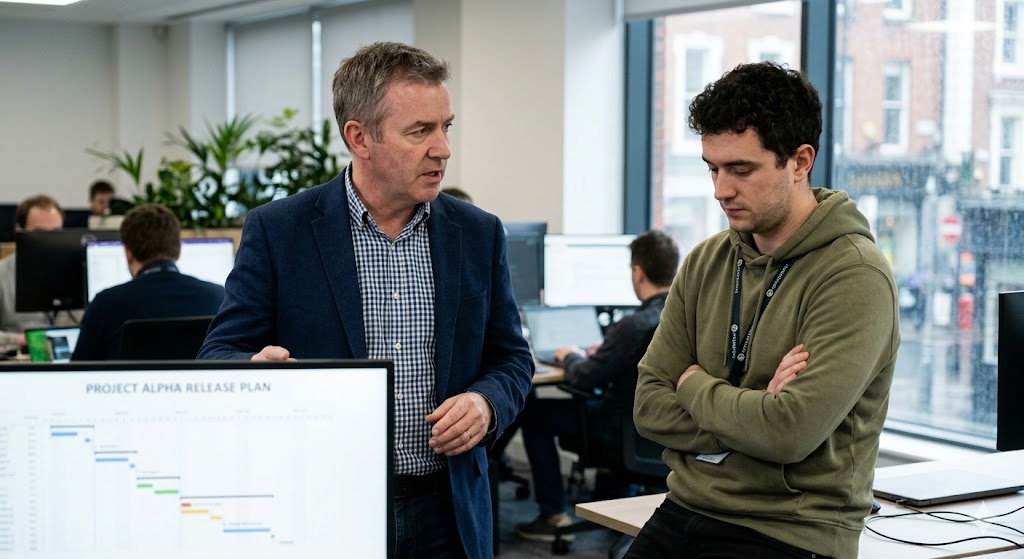
Many retail management teams believe they’re coaching their teams when they are simply not. In a recent Harvard Business Review study, most managers were shown to be very competent at guiding teams and giving instructions, but they mistakenly confused this with coaching. The two skills look similar in a short conversation and behave very differently over a year. The gap between them is what determines whether capability actually builds in a team, or whether the manager becomes the permanent bottleneck for every decision in the store.
The same study revealed a pattern inside the training itself: the skills participants struggled with most were recognising and pointing out strengths, and letting the coachee arrive at their own solution. Both of those failures come from the same root. Managers are rewarded in retail for being decisive, directive and quick. Coaching asks for something almost opposite, patience, observation, and the discipline not to jump in.
Why the gap persists
Most managers are told about coaching but rarely given the opportunity to learn it in a safe environment, one where it’s genuinely okay to make mistakes. The training, when it happens, is usually done in the workplace, in front of the team, with no room for error. Under those conditions, no new skill will land. Managers revert to what they know works, telling, because telling is a muscle they’ve already built.
“Coaching is a learned skill. It has to be practised, and it cannot be learned in one day.”
What actually works
If coaching is done properly, managers can materially increase employee engagement and overall business performance. But the environment has to be right. Here is the structure that consistently produces real coaching capability in retail teams.
Create a safe learning environment
Do not train managers in coaching inside their own store, with their own team present. The environment doesn’t allow the mistakes and feedback the learning needs. Train off-site, or at minimum, in a setting that lets managers experiment without performing for their team.
Managers coach each other, with a qualified coach in the room
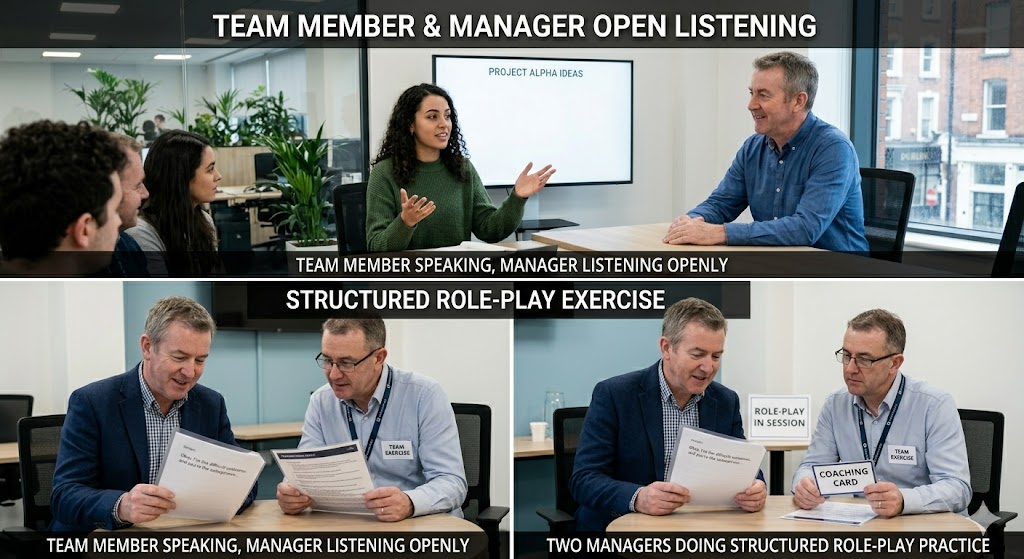
Have the managers take turns coaching and being coached by one another. Peer-to-peer learning embeds the skill much faster than classroom theory. A qualified external coach sits in, observes, and provides structured feedback on each manager’s approach, the kind of feedback they cannot give themselves or their peers in isolation.
Video and self-review
Ask the managers to video themselves coaching. Then ask them to watch themselves back, and write down what they observe, without prompts. The reflection written down from watching yourself is one of the most uncomfortable and most productive exercises available to a retail manager. It converts the external feedback into internal awareness.
Practise again, then again
Once the exercises are done and the learning objectives are discussed, ask the managers to do it again. Look for where they have put the feedback into practice. This iterative loop, coach, reflect, feedback, coach again, is what converts theoretical coaching into actual coaching capability. A one-day session cannot do this. Six to twelve months of cadenced practice can.
Why it matters commercially
A manager who can genuinely coach reduces their own load over time. The team gets better at diagnosing and solving their own problems. Decisions get made closer to the customer. Capability compounds. A manager who cannot coach, but thinks they can, remains the bottleneck for every decision, in perpetuity. One of those businesses scales. The other one doesn’t.
A question for your leadership team
How are you developing the managers in your business to coach? If the honest answer is “we sent them on a one-day programme,” the honest next step is to design a cadenced development programme with external coaching support. This is the core of my ongoing coaching work, cadenced sessions across six to twelve months with external coaching support, not a one-day course. A discovery call is usually where we start.